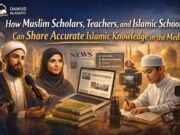


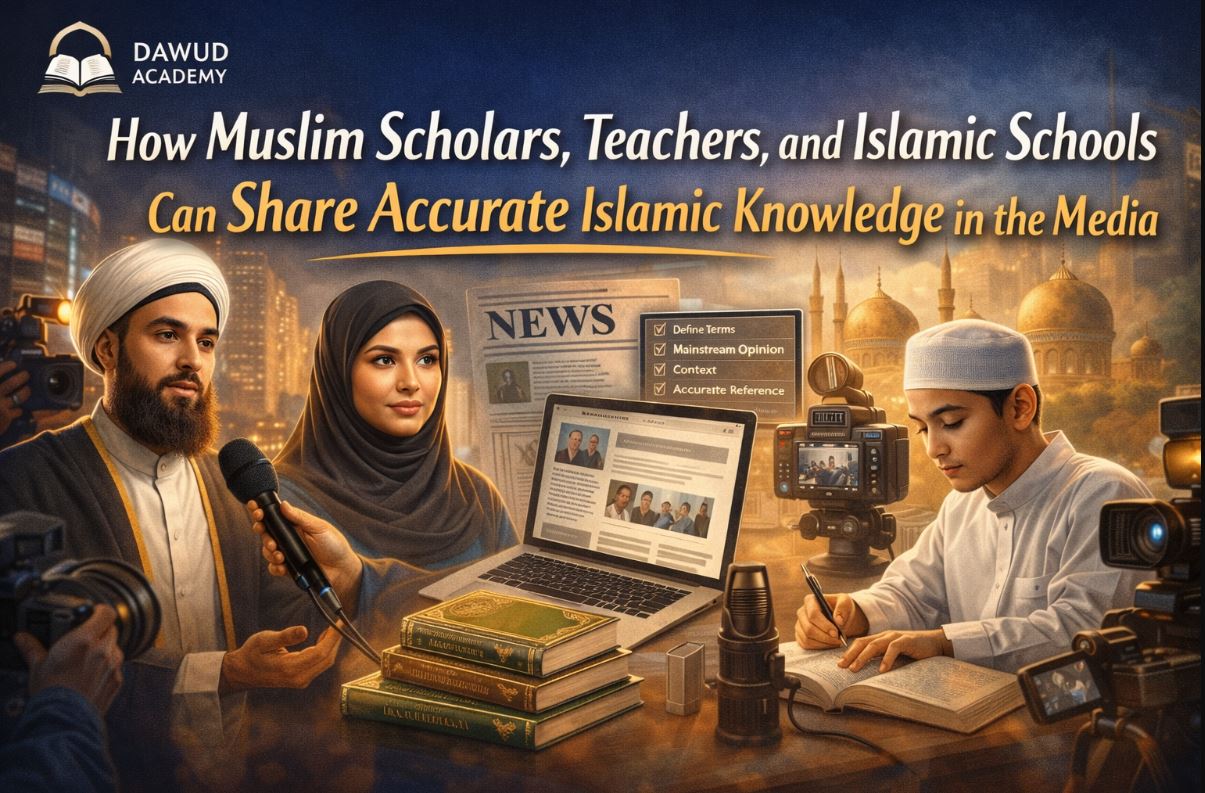
When Islam is discussed in public, a few sentences can shape how thousands of people understand an entire faith. Sometimes that discussion is thoughtful and fair. Other times it is rushed, simplified, or missing key context. This is why Muslim scholars, teachers, and Islamic schools have an important role to play in the media space today.
Sharing accurate Islamic knowledge publicly is not about winning arguments or chasing attention. It is about clarifying misunderstandings, offering guidance with wisdom, and representing the tradition with honesty and balance. The goal is clarity, not controversy. Benefit, not ego. Truth, not noise.
This guide is written for educators, institutions, and community leaders who want to contribute responsibly when journalists, podcasters, documentary teams, or online publications request Islamic input.
Start with intention and responsibility
Before anything else, check the purpose. In Islam, speech is worship when it is truthful, helpful, and guided by sincerity. Media engagement can become a form of service when the intention is to explain Islam accurately, protect people from confusion, and contribute to the public good.
At the same time, the public nature of media adds responsibility. A statement can be quoted out of context. A complex issue can be reduced to a headline. That is why scholars and teachers should approach media requests with calm, caution, and preparation.
A simple internal question helps: will this response increase understanding, reduce harm, and remain faithful to Islamic sources and scholarly method?
Understand what the media needs
Journalists work differently than students. They often need quick, clear answers. They have space limits. They work on deadlines. They may not have the background to ask the best questions.
This does not mean the media is hostile. It means the format is different.
If you understand the format, you can protect your message. Your job is to deliver clarity without losing accuracy. Their job is to produce a story that makes sense to a general audience.
When both sides are aligned, the result can be beneficial.
Choose what you can speak about with confidence
One of the most common mistakes is responding outside your area. In Islamic teaching, it is praiseworthy to say, I do not know. That principle applies even more in public settings.
A healthy approach is to define a clear scope for yourself and your institution.
Topics you can cover confidently might include foundations of belief, worship basics, Islamic history, ethical principles, family values, common misconceptions, and the difference between cultural practice and religious teaching.
If a question requires specialist knowledge, it is better to refer the journalist to a qualified expert rather than guessing.
Ask for the questions in writing
If a journalist calls and asks for immediate comments, it is perfectly fine to request the questions by email or message. This allows you to answer carefully, verify references, and avoid being rushed into unclear wording.
It also helps you understand what the journalist is actually writing about. Sometimes the first question is not the real topic. A written request reveals the direction of the story.
You can respond with a short message such as: Please send the specific questions and the context of your piece, and I will respond with a clear statement.
Build a simple accuracy checklist
Scholars and teachers can protect their message with a repeatable checklist. Here is a practical one that works well for most media requests.
First, define terms. Many misunderstandings come from vague language. Clarify what a word means before answering.
Second, provide the mainstream view. If there is scholarly difference, mention it calmly and briefly. Do not present fringe ideas as the norm.
Third, include context. Islamic rulings often relate to conditions, principles, and objectives. A short line of context can stop misinterpretation.
Fourth, avoid absolute claims unless you are certain. Use careful wording when needed.
Fifth, keep your answer focused. Long explanations can be edited down in harmful ways. A clear, compact answer is safer.
Sixth, if appropriate, offer one reliable reference that supports your point. You do not need to overquote. Just show that your statement is rooted.
Write media-friendly responses without losing depth
Many educators worry that simplifying will distort Islam. That concern is valid. But clarity and simplification are not the same.
A media-friendly answer is easy to understand and still correct. You can do that by using everyday language, avoiding internal jargon, and limiting your response to one main idea.
A useful format is: statement, brief explanation, and a gentle nuance.
For example, if asked about a topic that has debate, you can say: scholars agree on the principle, and there are different views on some details. Then explain the principle and mention that details vary by school and context.
This preserves truth while staying readable.
Do not allow sensational framing to shape your response
Sometimes a journalist will ask a question in a way that assumes a negative conclusion. This is common in polarizing topics.
Do not accept the framing. Reframe the question with calm language and then answer the reframed version.
If the question is built on an incorrect assumption, correct the assumption gently before continuing.
This is one of the most powerful ways to protect Islamic teaching in public spaces.
Prepare a media kit for your school or institution
Islamic schools and organizations should make it easy for media teams to engage responsibly. A basic media kit helps.
It can include a short institutional description, your mission, the topics you can speak about, short bios of your scholars or teachers, professional photos, and a short statement on your approach to accuracy and verification.
This builds trust. It also prevents journalists from relying on random online sources.
If your school or scholar team wants help handling journalist requests professionally while keeping Islamic accuracy and context intact, working with a digital PR agency can make outreach and responses more structured and reliable.
Decide who speaks and how statements are approved
For institutions, the biggest risk is inconsistency. Different staff members answering the same question differently creates confusion.
- Create a simple process.
- Choose official spokespersons.
- Create an internal review system for sensitive topics.
- Keep a record of what has been said publicly.
If needed, prepare short approved statements for recurring topics so your team is not reinventing answers under pressure.
Give quotes that can stand alone
Media outlets often use short quotes. That means your quote must be safe even when isolated.
- Avoid phrases that require paragraphs of context to make sense.
- Avoid sarcasm or emotionally loaded language.
- Avoid statements that could be misunderstood as endorsing something you do not endorse.
- Aim for wording that remains truthful and balanced, even if it appears as a single line.
Handle mistakes professionally
Even with preparation, misquoting or context loss can happen.
If something is wrong, respond calmly and in writing. Point out the exact issue and provide the corrected wording. Avoid public arguments. Most journalists will correct genuine errors if approached respectfully.
Also, learn from each experience. Improve your process and templates so the next request is smoother.
Use modern channels without becoming reactive
Not every public clarification has to be through traditional media. Many institutions now publish short statements, FAQs, and educational clips that journalists can reference.
But avoid reacting to every headline. A measured approach is stronger. Not every controversy deserves your attention. Focus on the issues where your input can genuinely reduce misunderstanding and bring benefit.
Conclusion
Accurate Islamic knowledge deserves careful delivery, especially in public spaces where simplification and misinterpretation are common. Muslim scholars, teachers, and Islamic schools can serve the ummah and wider society by speaking with sincerity, clarity, and responsibility.
The key is not to speak more. It is to speak better. Know your scope, ask for written questions, verify your wording, keep responses clear, and protect your message from harmful framing.
When done well, media engagement can become a form of dawah through truthfulness and wisdom, helping people see Islam with greater understanding and respect.